

The Broodmare Default: Why We Need to Talk About It
**Quick note: I'm NOT a vet and this isn't veterinary advice. What this is, is an honest conversation about welfare that I think is worth having. Always make sure to loop in your vet for decisions around your mare's health and breeding.**
The horse world should never be about blame. It should be about being brave enough to ask better questions for the sake of the horses. And here's one conversation that doesn't get asked about enough:
Pregnancy is hard enough on a sound body. So imagine what it asks of one that isn't.
Carrying a foal for almost a year is a physically enormous undertaking in general. A mare's weight changes significantly, her posture adjusts, and the load on her joints increases steadily with every passing week. For a mare in good health, her body is well equipped to handle that. Yes, it’s still hard and physically demanding, but not nearly as much as it is on an unsound mare.
So what about a mare who isn't sound? What does pregnancy ask of a body that’s already managing pain and discomfort, already compensating significantly, and already working harder than it should just to get around?
That question doesn't get asked enough.
The Broodmare Default: Why We Need to Talk About It
There are so many new welfare-based questions coming to light in recent times. Now, more than ever, we’re understanding more, asking more questions, and doing better with the new information we have. But there’s still an issue.
We listen to the gelding that suddenly became “difficult”… But mares are often so low in the list of considerations, that it’s time to start rethinking the way we look at breeding and mare care in general.
When the gelding starts showing signs of an issue under saddle he’s “the honest horse that’s got something going on,” but when it’s a mare, she’s “rude, arrogant, and mareish.” This is where the narrative needs to begin to shift.
Here's where I want to be really honest with you, because I see this more than I'd like to. Let’s paint a picture.
A mare starts showing resistance under saddle. She's labelled difficult, mareish, explosive, crazy, and the names go on. She's passed around, her behaviour is blamed, and eventually someone decides she's not suitable for ridden work… So she goes to the paddock to become a broodmare.
But here's what the research tells us:
Dr. Sue Dyson, one of the world's leading experts in equine lameness, developed the Ridden Horse Pain Ethogram. It’s a handy tool that identifies 24 behaviours in ridden horses, now understood to be associated with pain and discomfort. Behaviours we've long labelled as naughty such as resistance, bucking, and reluctance to go forward, are now recognised as potential indicators of underlying musculoskeletal problems. As Dr. Dyson puts it: "We’re conditioned to think that many horse behaviours are normal, when they’re not. We need to appreciate that what we call a 'naughty horse' may be a reflection of underlying musculoskeletal problems."
In other words, the mare wasn't being difficult. She was trying to tell us something, and instead of listening, we bred her. If problems aren’t recognised, they can lead to long term soundness issues throughout a horse's life. And breeding DOES NOT resolve that. It doesn't give her a break from pain or discomfort. It asks something absolutely enormous of a body that’s already struggling.
What Pregnancy Actually Asks of an Unsound Mare
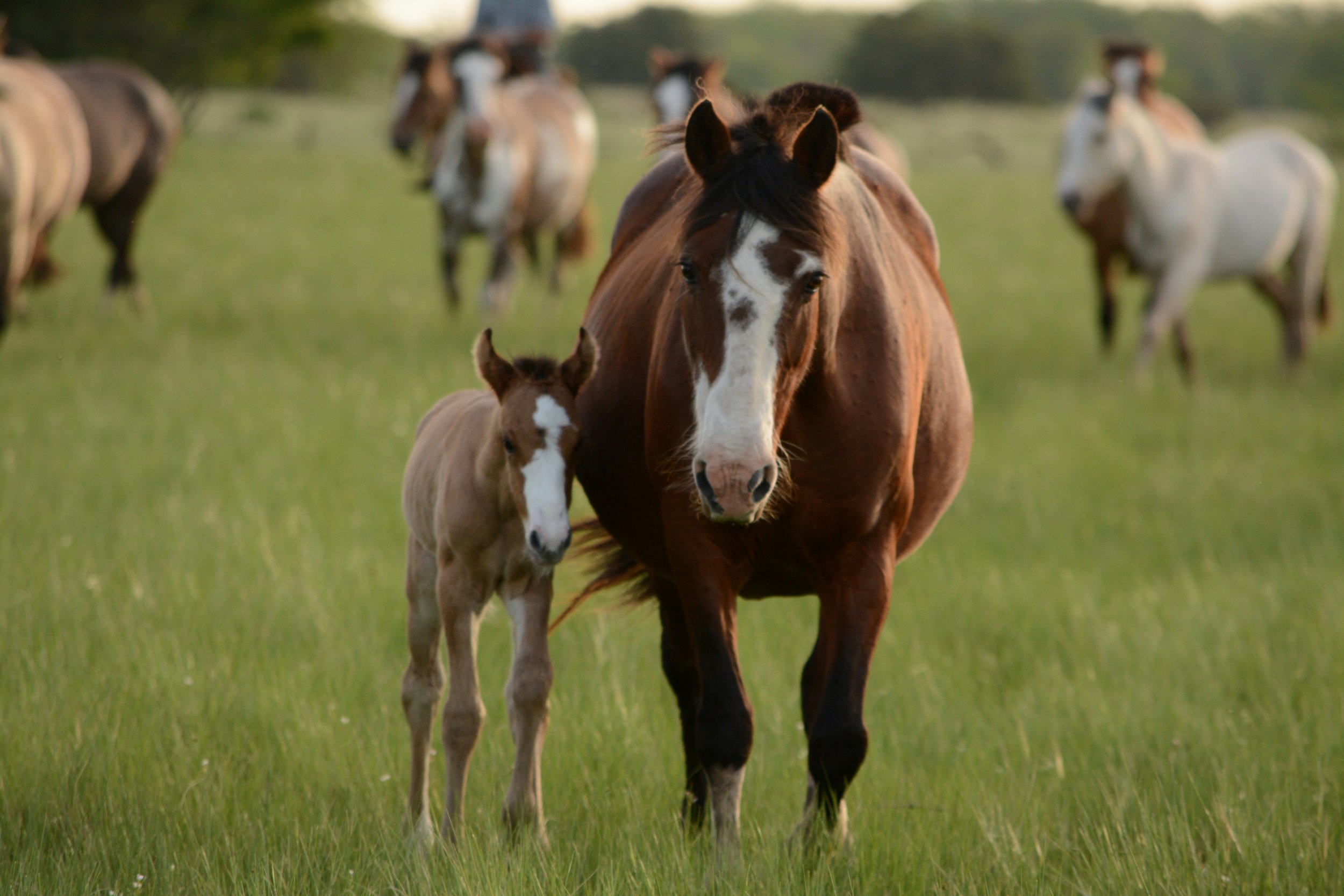
Let's talk about the physical reality… Pregnancy changes everything. A mare's centre of gravity shifts, her posture adapts to accommodate the growing foal, and the load on her body increases substantially.
For a mare already compensating from pain or discomfort, those changes don't happen in a neutral body. They happen in a body that’s already developed its own patterns. It has its own workarounds, its own areas of tension, its own patterns, and its own ways of protecting what hurts. Pregnancy adds to that load… It doesn’t take away from it or remove the problem entirely.
This matters not only for her comfort, but it also matters for the foal. Studies show that various stressors of the pregnant mare have been shown to affect the foal's size, cardiovascular function, and pituitary-adrenal function. Put simply, the environment a foal develops in, including the physical and hormonal state of the mare carrying them, shapes them in ways we’re only just beginning to fully understand.
The Foal We Don't Always Think About
Sure, we all think of the foal right? It’s cute, fluffy, and warms our heart with every new milestone. But beyond that, there’s something nobody really thinks about: the genetic piece of the puzzle and long-term soundness of the foal.
According to research, limb conformation defects significantly influence equine performance and welfare, with heritability estimates ranging from 0.12 to 0.30, suggesting meaningful genetic influence. In other words, many of the conformational faults that contribute to unsoundness can and will be passed on to the foal.
People who breed can often lack appropriate awareness of the relevance of heritability of common horse diseases, which may play a distinctive role in the cause of numerous conditions. Hereditary diseases that carry a risk of pain, suffering, or damage should be considered essential criteria in breeding decisions. But often, they’re not.
Remember: The foal born from an unsound mare doesn't just inherit her bloodlines. It may inherit her predispositions, her conformational faults, and the very things that made her “difficult” in the first place.
That foal will have its own life and its own body to live in. What are we setting them up for from day one?
Not Every Mare Is Meant to Be a Broodmare
And that's okay.
This is the part I really want you to hear, because I think there's a cultural pressure in the horse world that says a mare who can't be ridden must have a purpose, and that purpose is breeding. But retirement is a valid and complete option. Paddock life, love, care, and a soft landing are more than enough. To be fair, the most valuable things I’ve learned from horses have been on the ground. Riding is only a small part of the equation.
Not every horse with a uterus should be bred, just like not every stallion should be used at stud. Breeding decisions carry weight for the mare, for the foal, and for the industry's long term welfare standards. Asking these questions isn't about being judgemental or “overthinking it.” It's about being a responsible horse owner, and holding a higher standard for the animals who have no say in the decision.
The mares we breed deserve more than to be a default decision.
They deserve someone asking the hard questions for them. Not to shame, not to judge, but because they can't ask those questions for themselves.
If a mare spent her ridden career being labelled difficult, the very least we can do before breeding her is ask: What was she actually trying to say? And has anyone listened yet?
That's where good welfare starts.
Want to be apart of more welfare-focused conversations? Meet me on Instagram and Facebook!
References:
Dyson, S. and Pollard, D. (2023) 'Application of the Ridden Horse Pain Ethogram to 150 Horses with Musculoskeletal Pain before and after Diagnostic Anaesthesia', Animals. Available at: https://beva.onlinelibrary.wiley.com/doi/abs/10.1111/eve.13468 (Accessed: June 2026)
Ladewig, J. et al. (2022) 'A Review of the Ridden Horse Pain Ethogram and Its Potential to Improve Ridden Horse Welfare', Journal of Veterinary Behavior, 49, pp. 1–14. Available at: https://www.sciencedirect.com/science/article/abs/pii/S1558787822000685 (Accessed: June 2026)
Dyson, S. et al. (2022) 'An Investigation into the Relationship Between Equine Behaviour When Tacked-Up and Mounted and Epaxial Muscle Hypertonicity or Pain', Equine Veterinary Education. Available at: https://beva.onlinelibrary.wiley.com/doi/abs/10.1111/eve.13440 (Accessed: June 2026)
Novales, M. et al. (2024) 'Conformational Defects in the Limbs of Menorca Purebred Horses and Their Relationship to Functionality', NCBI/PubMed. Available at: https://www.ncbi.nlm.nih.gov/pmc/articles/PMC11011047/ (Accessed: June 2026)
Distl, O. (2009) 'Assessment of Hereditary Defects and Dispositions of the Horse Under Animal Welfare Aspects', PubMed. Available at: https://pubmed.ncbi.nlm.nih.gov/19333900/ (Accessed: June 2026)
Peugnet, P. et al. (2016) 'Management of the Pregnant Mare and Long-Term Consequences on the Offspring', Journal of Equine Veterinary Science. Available at: https://www.researchgate.net/publication/293015394 (Accessed: June 2026)
